Our Location
Industriestrasse 111
4147 Aesch
Switzerland


Credo EV 1202 Ref.
The first thing people notice is what isn’t there. No subwoofer, no wide cabinet, nothing that announces itself. Then the music starts, and the room fills: a double bass with real weight, a voice standing in front of you, an orchestra that doesn’t shrink to fit the furniture.
Quiet in appearance, the EV 1202 Ref. reveals itself on a closer look, in every detail of its build, and then in the music: full and even from top to bottom, clear when it gets loud, and never tiring.
01 · Listening
A spectacular sound is easy to fake for a few minutes. A little extra bass, a little extra sparkle, and every demonstration sounds impressive. At home, after an hour, the same loudspeaker starts to tire you, and you find yourself choosing the records it happens to like.
The EV 1202 Ref. goes the other way. Its scale comes from control: two midwoofers share the work, the bass goes deep without blooming, and the tweeter blends in instead of standing out. A string quartet keeps its air, a rock record keeps its punch, and late in the evening you are still listening, not adjusting.
Rudolf Kraske put it simply, years ago: listen into the music, without fatigue. It is still the brief.
02 · The room
From a close listening seat in a smaller room to an open living space, the EV 1202 Ref. keeps its balance. It takes little floor space and asks for no subwoofer in the corner. For cinema levels in very large rooms, there is Cinema LTM.
03 · Design
Credo has built slim floorstanding loudspeakers for a long time, and the EV 1202 Ref. comes straight from that line: from the AcusticA 1200 to the SPC 1200, the SPC 1202 MKII and today’s EV Reference. Each generation took the same idea further instead of starting over: a quiet column that brings the whole of the music into the room. The range carries it in its name: EV, for Evolution.
With the EV 1202 Ref., Michael Kraske took the next step. He chose two 5.5-inch sliced-paper midwoofers, whose cones stay calm where ordinary paper begins to break up, and a coated textile-dome tweeter, both custom-made for us in Denmark, and shaped the crossover around one question: does it sound right, in tone and in time? A high-pass filter ahead of a low bass-reflex tuning keeps the woofers composed when the music is loud, an idea that already appears in Rudolf Kraske’s crossover sketches from the early 1990s.
Read Michael’s design statement ↗ · Datasheet ↗
04 · Finishes
Piano Black, for rooms where the loudspeaker should recede. Oak Rough-Cut, for those who like to feel the grain. Swiss Pear High-Gloss, warm and deep. Every pair is veneered and matched together, and built in our workshop in Switzerland.


05 · Heard by others

“When I walked into the room I was looking for a subwoofer. I couldn’t believe the power and presence coming from the relatively small Credo speakers.”
HiFi Chicken · Anton Wyler, Capital Audiofest 2022 · Read ↗

“crystalline clarity that never gets edgy”
Twittering Machines · Michael Lavorgna, review · Read ↗

“Look closely, and you’ll see that precise Swiss approach to audio. Listen closely, and you’ll be as drunk on the sound as I am.”
Part-Time Audiophile · Marc Phillips, Capital Audiofest 2024 · Read ↗
06 · Specifications
Measurements
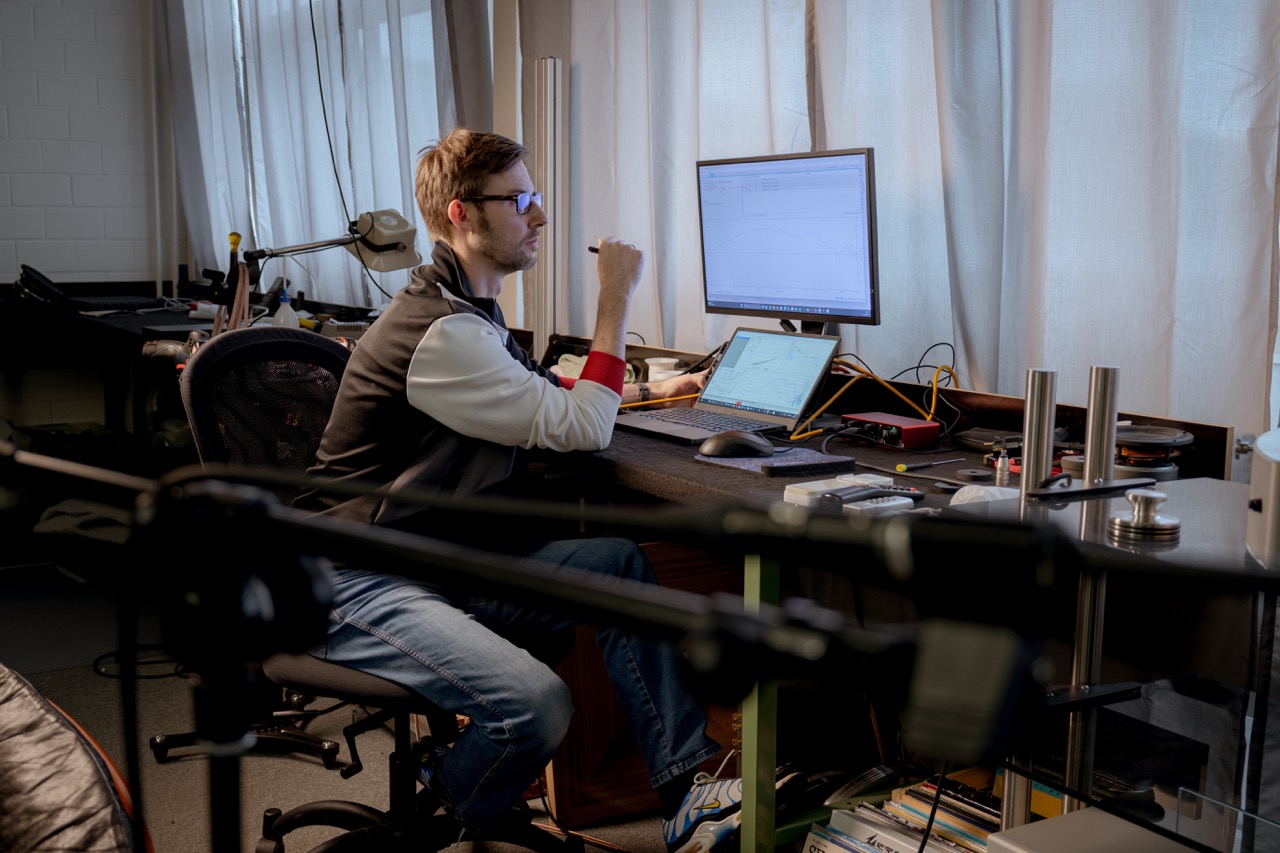
Listening decides, but measurement keeps the listening honest. The EV 1202 Ref. is measured to AES/CTA-2034-A: from 70 positions around the cabinet, to show how it will sound in a real room, not only straight ahead.
The predicted in-room response follows the preferred target curve almost perfectly: a smooth downward tilt of −2.39 dB per decade from midrange to treble, with only 5.8 dB of variation across the band. Without DSP correction. That gentle tilt is what makes a loudspeaker sound full-bodied and natural where you sit, at any volume.
There is no sharp presence peak around 2–4 kHz, a common trait of two-way loudspeakers. Voices stay clear and intelligible, yet nothing pushes forward. That is why you can listen for hours.
Sound reflected from walls, floor and ceiling follows the same smooth tilt, −2.35 dB per decade with minimal deviation from 250 Hz to 16 kHz. The directivity rises smoothly, with no dip at the baffle step and no beaming from the tweeter, so the reflections carry the same tonal colour as the direct sound. This is the basis of precise imaging and a believable sense of space, even in untreated rooms.
The step response is fast and phase-consistent: tweeter and midwoofers arrive together. In the cumulative spectral decay, the high frequencies die away in under a millisecond, without ringing. The start of a note is sharp, its end is clean, and that is where the precision comes from.
The measurements confirm what listeners have described for years: a loudspeaker that disappears into the room and leaves the music standing in it.
Listening level
Most music is enjoyed far more quietly than loudspeaker brochures suggest. Professional mixing rooms work to a reference level of 83 to 85 dB, with peaks about 20 dB higher. In a living room, the same music feels just as loud at 76 to 78 dB, because you sit closer to the loudspeakers and to the walls.
| Room volume | Typical room | Reference level |
|---|---|---|
| Under 42 m³ | small room, near-field | 74 dB |
| 42 – 142 m³ | typical living room | 76 dB |
| 143 – 283 m³ | large living room | 78 dB |
| 284 – 566 m³ | very large room | 80 dB |
| Over 566 m³ | cinema, concert-sized room | 83 dB |
This matters, because hearing changes with level. The equal-loudness contours, first mapped by Fletcher and Munson, show that the ear loses sensitivity to bass and treble as the level drops, while the midrange stays prominent. A loudspeaker has to keep its full balance at real living-room levels, not only when it is played loud.
It is also why we don’t chase high efficiency. A passive loudspeaker that stays linear down into the deep bass reaches about 89 dB per 2.83 V at most; a higher figure on paper is paid for with weaker bass, exactly where the ear needs help at home. We design each model for its room size and listening distance instead.
The amplifier follows from there. We calculate it the way cinema and studio engineers do, to the CEA/CEDIA method: room volume, listening distance, reference level, peaks and honest headroom. For the EV 1202 Ref., that typically means 60 W or more in a small room and around 100 W into 4 Ω in a medium-sized room. Tell us about your room, and we will calculate it for you.
07 · Questions and answers
A slim floorstanding loudspeaker for living rooms and listening rooms, made by Credo Audio in Switzerland since 2013. Two 5.5-inch midwoofers and a 1-inch tweeter, with bass down to 42 Hz. It is built to sound natural and whole, from top to bottom.
In most living rooms, no. The bass reaches 42 Hz at −3 dB and 32 Hz at −6 dB, and a high-pass filter keeps the woofers controlled when you play loud.
It depends less on the loudspeaker than on your room and how loud you listen. We calculate it from room volume, listening distance and reference level. As a guide: 60 W or more in a small room, around 100 W into 4 Ω in a medium-sized one, from an amplifier that is comfortable with a 4 Ω load.
From a close listening seat in a smaller room to an open living space, it keeps its balance. For cinema levels in very large rooms, Cinema LTM is the better choice.
Because it is not tuned to win a short demonstration. There is no exaggerated bass or treble to wear you out, the drivers are aligned in time, and the sound spreads evenly into the room. You notice it in the evening, when you are still listening.
Demonstrations are arranged directly with us, together with advice on room, amplifier and placement: credo-audio.ch/contact.
Next step
The records you know best tell you more than any specification. Bring them along, and we will set up the system with you: loudspeakers, amplifier, placement. Then sit down, take your time, and listen.
Press
Reviews and show reports from the past years, each linked to the original.
Part-Time Audiophile
Marc Phillips · Capital Audiofest 2025
“To me, they’re perfectly balanced with just enough of that desired warmth so that the music just flowed through that intimate room …” Read ↗
Part-Time Audiophile
Marc Phillips · Capital Audiofest 2024
“Look closely, and you’ll see that precise Swiss approach to audio. Listen closely, and you’ll be as drunk on the sound as I am.” Read ↗
Part-Time Audiophile
Best Sound at Show · Capital Audiofest 2024
“… a tonality that is smooth and seductive and natural.” Read ↗
Part-Time Audiophile
Buyer’s Guide · Best Tower Loudspeakers 2024
“A quietly extraordinary transducer …” Read ↗
HomeTheaterHifi
AXPONA 2025
“The whole system just sounded effortless …” Read ↗
HomeTheaterHifi
Carlo Lo Raso · AXPONA 2024
“They had a sense of completeness to their sound.” Read ↗
Part-Time Audiophile
Marc Phillips · Credo Factory Tour, 2023
“They just seemed to do everything I wanted them to do.” Read ↗
Twittering Machines
Michael Lavorgna · Capital Audiofest 2023
“… filled Room 730 with pure, sweet music.” Read ↗
ecoustics
Ian White · Capital Audiofest 2023
“One had to listen into the music and allow the music to surround them.” Read ↗
Part-Time Audiophile
Marc Phillips · FLAX 2023
“… a stupendous sense of top-to-bottom coherency …” Read ↗
Twittering Machines
Michael Lavorgna · Review, 2022
“The Credo are an exceptionally clean sounding speaker, as if music pours through them with ease untouched and uncolored.” Read ↗
Part-Time Audiophile
Eric Franklin Shook · Capital Audiofest 2022
“The EV1202 made me want to close my eyes and listen without focusing on the gear.” Read ↗
HiFi Chicken
Capital Audiofest 2022
“The detail was spectacular, high frequencies were airy and light …” Read ↗
Stereophile
T.H.E Show 2022
“… fine, clear, all-of-a-piece sound …” Read ↗